RC Corner Weight Calculator
Enter the weight measured at each wheel to see cross-weight (wedge), left/right balance, and front/rear bias. Works for all RC car scales and classes.

Free · iOS & Android
Get this Calculator on your Phone
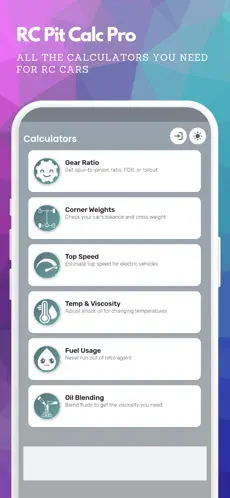
Pit Calc Pro lets you calculate corner weights, gear ratios, oil viscosity, and more!


Front
Rear
Cross-weight (wedge)
Enter the weight at all four corners to see cross-weight and balance.
How to use this calculator
- • Place your RC car on a corner weight scale or four individual scales.
- • Enter the weight reading at each wheel in the corresponding corner above.
- • Cross-weight (wedge) is the percentage of total weight on the left-front + right-rear diagonal. A perfectly balanced car reads 50%.
- • Most oval racers aim for cross-weight between 48–52%. Road course and off-road cars benefit from being as close to 50% as possible.
- • Front bias tells you how much of the total weight sits on the front axle — useful for tuning initial turn-in vs. rear traction.
- • Left bias matters most for oval racing; road course and off-road cars should be close to 50%.
- • To adjust cross-weight, try shimming the ride height at opposite diagonal corners, or repositioning battery and electronics.
- • Your settings are automatically saved for your next visit.
What is cross-weight in RC cars?
Cross-weight — also called wedge — is one of the most important balance measurements in RC racing. It tells you how evenly the car's weight is distributed across its two diagonals: right-front + left-rear vs. left-front + right-rear.
A car with 50% cross-weight is perfectly balanced, meaning it will handle identically turning left and turning right. If cross-weight drifts more than a couple of percent from 50%, the car will feel different in left vs. right corners — typically pushing in one direction and getting loose in the other.
In full-size racing, crews adjust wedge intentionally for oval tracks. In RC, the goal is almost always 50% cross-weight, because most tracks have both left and right turns. Common causes of uneven cross-weight include an off-center battery, uneven ride height, or a slightly twisted chassis.
To measure corner weights, place the car on a flat surface with four individual scales (one under each tire) or a dedicated RC corner weight system. Record each reading, enter them above, and this calculator does the rest.

See How You Really Drive
Every race graded: wins, TQs, consistency, and 52 trophies. Photo the results, it logs itself.
More RC Calculators
Free RC tools to dial in your car between rounds.
Drivetrain
RC Gear Ratio Calculator
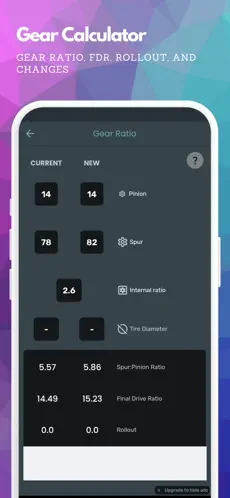
Pinion + spur + internal ratio → final drive ratio, rollout, and chart of nearby combos.
RC Speed Calculator
Motor Kv, battery voltage, gearing, and tire size → top speed of any electric RC car.
RC Pinion Recommender
What pinion should I run? Pick your car and motor; get a starting pinion from real race setups, with the range racers run.
RC Gear Ratio Chart Maker
Build a printable pinion/spur chart for any class: gear ratio (FDR) or rollout (mm). 1/10, 1/12 pan, 1/8 presets included.
RC Crawl Ratio Calculator
Total motor-to-wheel reduction for crawlers and trail trucks: pinion, spur, transmission, axle and portal gears.
RC Battery Runtime Calculator
How long will your LiPo last? Estimate runtime by class and driving style.
Shocks
Chassis & Suspension
RC Pill Insert Calculator
Suspension pill inserts: see how a position change moves arm sweep, kick-up, anti-squat and track width. 232+ models.
Mini-Z Wheel Offset Calculator
Fitting an AutoScale body to a Kyosho Mini-Z? Get the exact wheel offset for any width, plus a wheelbase & motor-mount reference.
Free app
Pit Calc Pro
Have this calculator handy at the track
Pit Calc Pro puts this corner weight calculator — and 8 more tools — right on your phone, so you're never without it when you need it most.
- Corner weight calculator
- Gear ratio & FDR
- Pill insert geometry
- Top speed calculator
- Shock oil viscosity
- Fuel usage