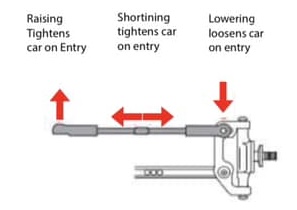
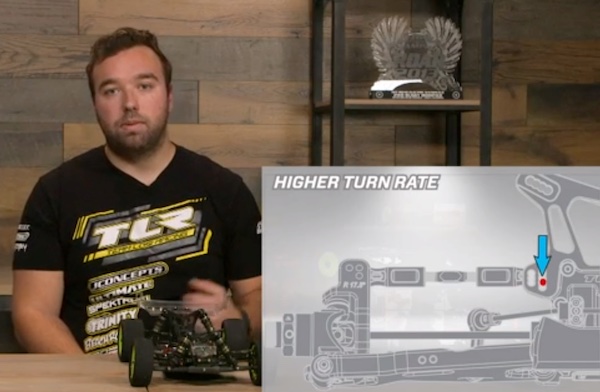
The camber link is the upper link that attaches the wheel's hub to the bulkhead. In most cars this is a tie-rod with ball cups at each end, but in some cars (especially large scale) it is an arm, similar to the lower arm.
Changing the length of the camber link adjusts the camber. Changing its mounting positions can affect roll center or camber gain, or both. Read on for details:
Front Camber Links
More negative camber
- More traction through turns
- More aggressive steering
Less negative camber (more upright)
- More traction in straights
- Less steering
- Car feels easier to drive
Raised at the bulkhead
- Lower roll center
- Less camber gain (camber change during compression)
Lowered at the bulkhead
- Higher roll center
- More camber gain (camber change during compression)
Raised at the hub
- Less roll, higher roll center
Lowered at the hub
- More roll, lower roll center
Shorter camber links
- More roll
- Generally suited for low-grip, bumpy tracks
Longer camber links
- Less roll
- Generally suited for smooth, high-grip tracks
Rear Camber Links
More negative camber
- More cornering grip
- Less straight-line traction
- Less high-speed stability
Less negative camber (more upright)
- More straight-line traction
- Less stability in turns
- Less traction in turns
- More high-speed stability
- Slight positive camber (leaning outward) can improve straight-line acceleration on loose tracks, but is otherwise not recommended
Higher at the bulkhead
- Lower roll center
- Less camber gain (camber change during compression)
Lower at the bulkhead
- Higher roll center
- More camber gain (camber change during compression)
Higher at the hub
- Less roll, higher roll center
Lower at the hub
- More roll, lower roll center
Shorter links
- More roll
- Faster on-power square-up
- Generally suitable for low-grip tracks
Longer links
- Less roll
- Less on-power understeer on high-grip tracks
- Generally suitable for high-grip tracks


Camber Gain
Camber gain is the amount the camber changes as the suspension is compressed. To increase camber gain, lower the camber link at the bulkhead or raise it at the hub, or shorten the camber link.
Less camber gain
- Less initial steering
- Less grip mid-corner to corner exit
- Less steering responsiveness
More camber gain
- More initial steering
- More grip mid-corner to corner exit
- More steering responsiveness
To increase camber gain, shorten the link at either end. To decrease camber gain, lengthen it.


.avif)

.avif)