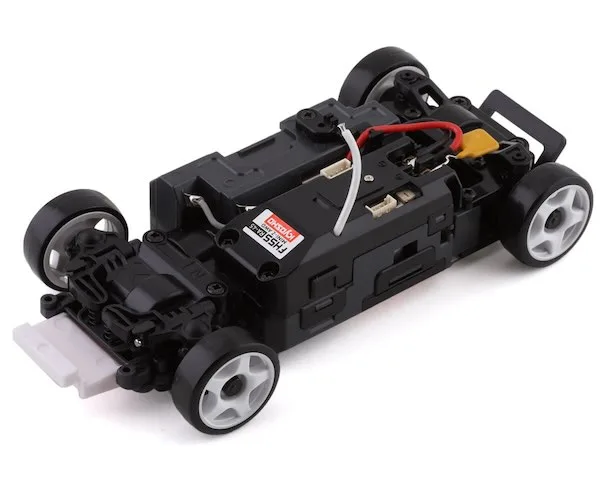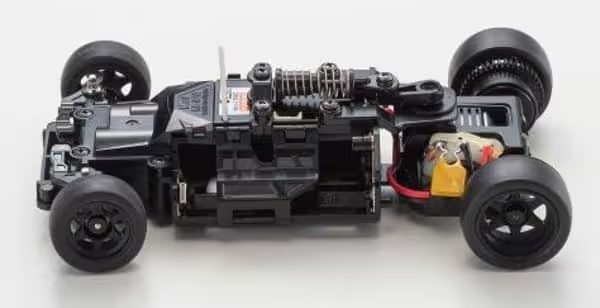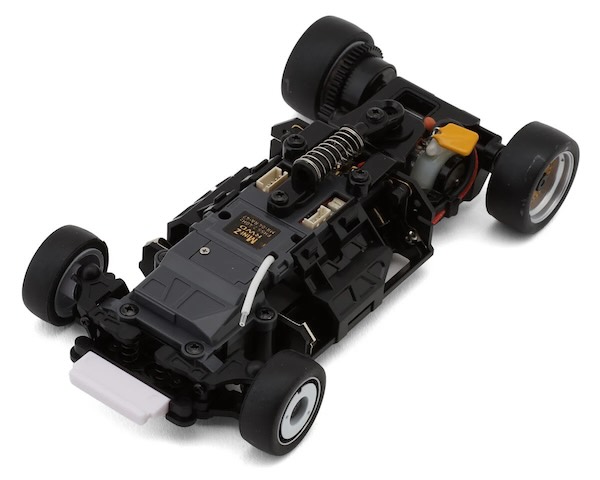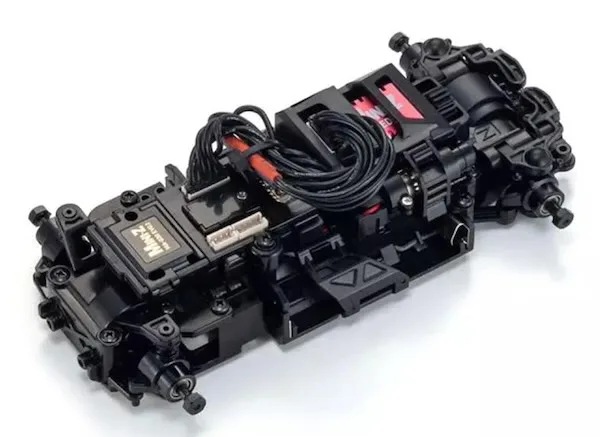

Bought a beautiful AutoScale body — a Skyline, an NSX, a GT3 car — only to find the wheels sit too far in, poke out past the arches, or the shell won't sit down on the chassis? That is the most confusing part of the Mini-Z platform: you configure the chassis to match the body, not the other way around.
Two things control the fit. Wheelbase (the distance between the axles, set by your motor mount and rear pod) decides whether the body physically fits. Wheel offset (how far each wheel sits in or out, set by the wheels) decides whether it looks right and the tyres do not rub. Get the wheelbase right and the body fits; get the offset right and it sits right.
Wheelbase vs offset: the two things that matter
Keep these separate in your head and most fitment confusion disappears:
- Wheelbase — front-to-back axle distance, set by the motor mount and rear pod. If the shell will not sit down or the arches do not line up with the wheels, this is your problem.
- Offset — how far each wheel face sits out from the hub, in mm, set by which wheels you fit. If the wheels tuck inside the arches, or poke out and rub, this is your problem.
Wheelbase makes it fit; offset makes it look right.
Rear pod and motor mount: why the letters are confusing
Mini-Z mounts are labelled RM, MM, LM and HM — but the letters mix up two different things, and even the RC community does not agree on what some of them stand for. Do not trust the letters alone; check the wheelbase in mm and your body's spec sheet.
The letter describes one of two things:
- Where the motor sits front-to-back (this mainly sets wheelbase and balance):
- RM — "Rear Motor" (some say "Regular Mount"): motor behind the rear axle. Short wheelbases (86–94 mm). Most rear grip and the sharpest corner entry; rotates less and can understeer on power. Fits the most bodies.
- MM — "Mid Motor": motor ahead of the rear axle. Long wheelbases (98–106 mm). Balanced, rotates and exits corners well, the most stable — the beginner-friendly choice.
- How the motor is mounted for height (this mainly sets centre of gravity):
- LM — usually "Low Mount": a low centre of gravity for a fast, stable car, but only a few bodies fit. Note: Kyosho's own blog also uses "LM" for a long 102 mm mount, so this letter is genuinely ambiguous — always check the mm.
- HM — "High Mount": the motor sits on top of the axle to fit tall, short compact-car bodies. The high weight makes the car tip more easily.
- MM2 / MML — newer mid-mount variants that drop the motor lower for a lower centre of gravity at the same wheelbase.
Bottom line: the wheelbase in mm is the number that matters; the letter is just a hint.
Mini-Z wheelbase options
Kyosho sizes wheelbase with both a letter code and a millimetre figure, and every AutoScale body is labelled with the wheelbase it needs.
| Code | Wheelbase | Typical mount | Character |
|---|---|---|---|
| S | 86 mm | RM | Shortest — twitchy, hardest to drive |
| M | 90 mm | RM | Short, nimble |
| L | 94 mm | RM (also HM, MM2) | Common scale wheelbase |
| LL | 98 mm | MM (also MML, MM2) | Most stable — beginner-friendly |
| 3L | 102 mm | MM / LM (also MML, MM2) | Very stable, slower to rotate |
| 4L | 106 mm | MM (also MML) | Longest — niche |
Kyosho's official mount spec sheet: diff, motor case, spring & wheelbase by pod type
Kyosho's own in-store pod-type reference cards spell out exactly which parts come on each mount — useful if you're buying a replacement pod, diff, or spring and want the number that actually fits. RM and HM share the same wheelbase range and are both field-changeable across S/M/L; MM and LM are fixed at their listed wheelbase.
| Mount | Diff gear | Motor case | Rear spring | Suspension parts | Wheelbase |
|---|---|---|---|---|---|
| RM | RM · Diff gearMZ207 (opens in new tab) | RM · Motor caseMZ216B (opens in new tab) | MZW213 (20 mm) | RM · Suspension partsMZ403B (opens in new tab) | S (86 mm) / M (90 mm) / L (94 mm) — changeable |
| MM | MM · Diff gearMZ207 (opens in new tab) | MM · Motor caseMZ215B (opens in new tab) | MZW202 (opens in new tab) (23 mm) | MM · Suspension partsMZ403B (opens in new tab) | 98 mm (LL) |
| LM | LM · Diff gearMZ302 (opens in new tab) | LM · Motor caseMZ305B (opens in new tab) | MZW202 (opens in new tab) (23 mm) | LM · Suspension partsMZ403B (opens in new tab) | 102 mm (3L) |
| HM | HM · Diff gearMZ207 (opens in new tab) | HM · Motor caseMZ156B (opens in new tab) | MZW213 (20 mm) | HM · Suspension partsMZ403B (opens in new tab) | S (86 mm) / M (90 mm) / L (94 mm) — changeable |
The LM card's fixed 102 mm figure also confirms the ambiguity flagged above: Kyosho really does use "LM" for both a low-mount and a long-wheelbase pod, so treat the letter as a hint and the mm figure as the source of truth.
AWD tread and wheelbase conversions (MA-020, MA-030, MR-04EVO2)
AWD pods use their own hub and tread system, so the conversion parts are specific to each chassis:
- MA-020 ships narrow tread on AWD-only wheels (MDH-series hubs — not interchangeable with RWD wheels). To convert narrow to wide tread you need MD202 (opens in new tab) (front suspension arm), MD203 (opens in new tab) (front upper arm cover), and MD205 (opens in new tab) (long universal shaft). Wheelbase is M (90 mm) stock, changeable to LL (98 mm) with MDW100-04 (spur gear set) and MDW205B (opens in new tab) (wheelbase extension block, LL/98 mm).
- MA-030 / MA-030EVO2 kits (for example the Narrow-LL No.32180 (opens in new tab) and the MA-030EVO2 No.32181 (opens in new tab), both 8500KV) include front tread-conversion parts in the box — no separate purchase needed to change front width. Wheelbase runs 94 mm stock, changeable to 98 mm.
- MR-04EVO2 kits (No.32893G (opens in new tab), No.32894 (opens in new tab), No.32895 (opens in new tab)) all include front width-change parts as standard kit contents, plus a set of 6T/7T/8T/9T pinion gears.
How to read what a body needs (the part-number trick)
Kyosho prints the recommended chassis setup right in the AutoScale part number. Learn to read it and most of the guesswork disappears.
| In the part number | Means | Example |
|---|---|---|
| MR-03N | Narrow chassis (front/rear width under ~70 mm) | MR03N-RM |
| MR-03W | Wide chassis (over ~70 mm) | MR03W-RM |
| -RM / -MM / -LM | Recommended motor mount, which tells you the wheelbase | -RM ≈ 94 mm, -MM ≈ 98 mm |
| Offset line (F / R) | Recommended front and rear wheel offset | F: Narrow +1.5 / R: Wide −1.0 |
Example: ASC MR03N-RM Honda NSX means narrow chassis, rear-motor, 94 mm wheelbase. The listing's offset line (for example "F: Narrow +1.5 / R: Wide −1.0") tells you exactly which wheels to run.
On the current MR-04EVO2 platform Kyosho folds the pod letter straight into the kit name: W-MM means wide tread at 98 mm (LL) wheelbase (No.32893G (opens in new tab), 8500KV with V2 gyro; No.32894 (opens in new tab), 5600KV, gyro-less), and N-MM2 means narrow tread at 94 mm (L) wheelbase (No.32895 (opens in new tab), 4100KV, gyro-less). On the AWD side the MA-030EVO2 (No.32181 (opens in new tab)) ships as N-LL — narrow tread, 8500KV sensored brushless — with wheelbase support for both 94 mm and 98 mm (LL).
AWD body compatibility: native fit vs a wheel change
Kyosho publishes a full native-fit and wheel-change list for each AWD chassis on the box and its site; the MA-030EVO2 sheet alone runs close to thirty bodies, so here's a sample rather than the whole list. Bodies like the Nissan GT-R R35 (MZP417), Subaru WRX STI (MZP440), Toyota GR Supra (MZP450), and Toyota Sprinter Trueno AE86 (MZP465 (opens in new tab)) mount natively. Others fit only after a wheel change — the Honda NSX (MZP233) and Chevrolet Corvette C8.R (MZP244 (opens in new tab)) need one, and a few McLaren shells, including the McLaren P1 GTR (MZP235), are flagged "DWS not possible" even with the wheel change, meaning they aren't compatible with drift-wheel-and-steering setups. Always check the body's own fitment note rather than assuming a wheel change alone clears every McLaren shell.
The offset rule (and a calculator to do the maths)
Offset is measured in mm. A bigger or more-positive number pushes the wheel further OUT (wider); a negative number tucks it IN. Front and rear are set independently. Factory wheels come as narrow (8.5 mm wide) in offsets 0 / 1.0 / 1.5 / 2.0 / 2.5, and wide (11 mm) in offsets −1.0 / 0 / 1.0 / 2.0 / 3.0. Wide is about 5 mm wider overall — roughly 2.5 mm of offset per side.
Every AutoScale body lists a recommended width and offset. Add them to get a target total, and keep that total constant when you change wheel width: needed offset = target total − wheel width. For example, a 98 mm body spec'd at narrow (8.5) + offset 1.5 = 10.0 total; to run wide (11) rears, the offset = 10.0 − 11.0 = −1.0, so you fit "wide −1" wheels.
Use our Mini-Z Body Fitment and Offset Calculator → to work this out for the front and rear in one step.
Step by step: fitting an AutoScale body
- Read the body's spec — the part number plus the front/rear offset line. Note its wheelbase and offsets.
- Match the wheelbase first. Set your motor mount and rear pod to that wheelbase (for example 94 mm RM vs 98 mm MM). This decides whether the shell sits on the posts.
- Match narrow vs wide. If the body is wide and your chassis is narrow (or vice versa), swap the front upper and lower plates and the tie-rod, and use the matching rear pod width.
- Set the offset. Fit the wheels the body calls for. Unsure? Try +2.0 on the front first — it solves most MR-03 fit problems.
- Check for rub at full steering lock and full suspension compression before you run.
Wheels and offset: a durable, non-wobble fit
Wheels that wobble or crack usually come from one of two things: an offset that forces the tyre against the arch (constant rubbing stresses the rim), or cheap rims on a high-grip surface. Use the offset the body specifies rather than forcing a wider stance, seat the wheel fully on the hex, and step up to a sturdier rim if you race on high-grip carpet or PCB. One more gotcha: Mini-Z RWD and AWD wheels are not interchangeable — the hub geometry is different.
Deciding between chassis, or whether to upgrade what you have? See Mini-Z MR-03 vs MR-04: what's different and how to upgrade.
Dialing in your wheels? See Mini-Z wheels: offset, play & a fit that won't wobble or crack.
Mount, wheelbase, and part-number specs in this article are drawn from Kyosho's 2026 catalog and official reference materials.