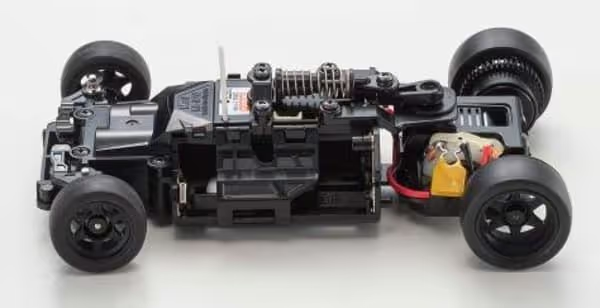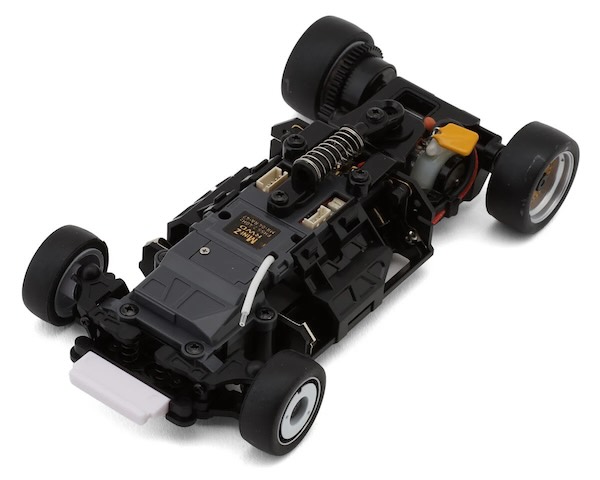

"MR-03 or MR-04?" is the most common Mini-Z buying question — but it is really four cars, because each generation has a brushed base version and a brushless EVO race version. The MR-04 platform is Mini-Z's first full redesign in 14 years (about 98% new parts) — it debuted via the MR-04EVO2 at the end of 2023 and picked up a further minor update in 2026 — yet a lot carries straight over, and most of what makes a Mini-Z fast bolts onto what you already own. Here is the plain-English breakdown.
The Mini-Z lineage (base vs EVO)
Sorting out the names clears up most of the confusion:
| Chassis | Motor | Electronics | Who it is for |
|---|---|---|---|
| MR-03 (base) | Brushed | Proven, simpler board | Bashing, casual, budget |
| MR-03 EVO | Brushless | Separate ESC + receiver; ICS-adjustable; far faster ESC; can switch back to brushed | MR-03 racers |
| MR-04 (base) | Brushed | New, larger board | Newcomers wanting the latest chassis |
| MR-04 EVO2 | Sensored brushless (8500 / 5600 / 4100 KV) | New potentiometer + overhauled steering program; RC unit built for RPM-based Mini-Z Cup regulation; V2 gyro (own CPU) standard only on "G"-suffix kits | MR-04 racers |
Key point: the base MR-04 is still a brushed car — only the EVO2 gets the sensored motor and upgraded electronics.
The V2 gyro isn't automatically part of every EVO2 kit. Kyosho's 2026 lineup splits by suffix: No.32893G (opens in new tab) (W-MM/8500KV) ships with the V2 gyro standard, while No.32894 (opens in new tab) (W-MM/5600KV) and No.32895 (opens in new tab) (N-MM2/4100KV) are gyro-less — Kyosho's parallel No.32894G (opens in new tab) and No.32895G (opens in new tab) follow the same pattern, bundling the V2 gyro (No.MZW712 (opens in new tab)) as standard where the plain SKU ships without one. "W-MM" chassis run the wider, 98mm-wheelbase LL length; "N-MM2" runs the narrower, 94mm L length.
What changed from the MR-03 to the MR-04
| Area | MR-03 | MR-04 |
|---|---|---|
| Front suspension | Limited up-travel (racers hand-do the "kingpin flip") | Factory kingpin flip — more travel out of the box; knuckle reshaped to the MA-030 (AWD-derived) type for better camber stability, with ball-joint upper arms and revised caster/trail geometry for more linear steering |
| Front springs | MR-03-specific rate | New MR-04-specific spring rate, with additional hardnesses sold as options |
| Steering geometry (scrub radius) | Baseline | King-pin offset (scrub) reduced 1.5 mm per side → sharper turn-in and less wheelbase change mid-corner |
| Motor position | Higher in the rear pod | Sits lower (bottom of the rear pod) → lower centre of gravity |
| Battery position | Higher | Lower — the bay was dropped and the chassis reshaped around it, for a lower centre of gravity and steadier cornering |
| Front bearings | Smaller (smaller front axle) | Larger — all 7 are now a low-friction 3mm inner-diameter type (MR-03 fronts do not fit) |
| Servo feel | Calmer; "tracks straighter" | Quicker and more sensitive (it may buzz hunting centre — normal) |
What the EVO versions add
MR-03 EVO turns the MR-03 into a race chassis: brushless power, a separate ESC and receiver (works with multiple transmitter brands), an ICS-adjustable board (tune throttle and steering, or even switch back to a brushed motor), and far faster ESC response. MR-04 EVO2 adds a sensored brushless motor (smooth from a standstill, where sensorless motors can cog), a new higher-precision potentiometer with an overhauled steering program, and — on "G"-suffix kits — a V2 gyro with its own CPU for finer control and faster response. In both generations, "EVO" means the brushless, adjustable-electronics race upgrade.
The EVO2 chassis itself debuted at the end of 2023 — Mini-Z's first full model change in 14 years, carrying over the well-liked MR-03 layout while adding the sensored motor, redesigned front suspension and lower-CG battery bay described above. A 2026 minor update layered on the reinforced Front Suspension Arm 2.0 (previously fitted only to the RWD readyset line) as standard across the whole EVO2 range, plus a new RC unit built for the current Mini-Z Cup rulebook: since 2025, the Cup has regulated actual motor RPM rather than motor KV rating, and the EVO2's RC unit supports that RPM-based control, with per-class settings adjusted through Kyosho's free I.C.S. Setting Manager software.
The MR-04 readyset line: a separate, ready-to-run platform
Everything above describes the EVO2 chassis kit line — the "build it, race it" side of MR-04. Kyosho also sells the MR-04 chassis as a complete readyset: chassis, painted body and KT-531P transmitter, ready to drive out of the box. The 2026 catalog markets these readysets (for example, the VW Beetle 1966, No.32374BBL in Pahama Blue and No.32374RR in Ruby Red) as the debut of the "4th-generation" Mini-Z RWD platform, on a chassis derived from the flagship EVO2 but redesigned specifically for readyset use.
Readyset-specific details worth knowing before you buy one, or before you go looking for parts to cross over to your EVO2:
| Feature | What it means |
|---|---|
| Ball bearings | 17 total (full-bearing spec) to cut drivetrain loss |
| Rear damper | Oil-spring type standard; upgradable to Kyosho's optional oil damper |
| LED lighting | Built-in light-unit connector accepts Kyosho's clear & red LED unit (No.MZW429R (opens in new tab)) — but per Kyosho's own option-parts listing, that LED unit is not compatible with EVO-series (MR-04EVO2) chassis. Working lights are a readyset-line perk only. |
| Battery position | Lower than MR-03, the same lower-CG benefit as the EVO2 side of the family |
If you already own an EVO2 chassis, don't buy the LED unit expecting it to fit — and if factory-fitted lighting matters to you, that points toward the readyset line rather than a bare EVO2 kit.
What carries over between the two
Trading up never wastes your collection:
| Part | MR-03 ↔ MR-04 |
|---|---|
| AutoScale bodies | Yes — all Mini-Z bodies fit both |
| Wheels & tyres | Yes — same narrow 8.5 / wide 11 + offset system |
| Rear differential | Yes — identical (only LM vs mid-motor diffs differ) |
| Rear shock | Yes — same shock (the mount differs) |
| Rear motor pod (low-CG) | Retrofittable to an MR-03 — see below |
| Front bearings | No — MR-03 fronts are smaller |
| Front knuckles / kingpins / springs | No — MR-04-specific |
| Board / servo | No — the chassis is shaped around them |
Bonus: put the MR-04's low rear motor pod on your MR-03 for about $10
One of the MR-04's best features — the lower, lower-CG rear motor pod — bolts onto an MR-03. Kyosho sells the whole conversion as a single part, MZ714 (about $10–13): motor housing, ride-height pills, motor plates and shock hardware. Because the rear shock and differential are identical, you reuse them. Two small gotchas: the MR-04 motor wires exit forward (re-route or re-solder if you keep your MR-03 motor — or just fit a fresh one), and the non-drive-side rear spacer is about 1 mm shorter (trim your MR-03 one, or buy part MZ206C; some also lightly file the MR-03 drive hub). About 5–10 minutes of work for the MR-04's lower-CG rear end on your existing chassis.
Should you buy an MR-04 or upgrade your MR-03?
Upgrade your MR-03 for cheap speed and grip — bearings, a ball diff, an alloy mount, good tyres and brushless all bolt on, and you can even retrofit the MR-04's low rear motor pod for about $10. Step up to an MR-04 (or EVO2) mainly for the front-end steering geometry (the factory kingpin flip, MA-030-type knuckle and revised scrub/caster) and, on the EVO2, the sensored power — plus the V2 gyro if you pick a "G"-suffix kit — those are the parts that do not retrofit to an MR-03. If you'd rather have a complete, ready-to-run car than a bare chassis kit, the MR-04 readyset line (factory paint, transmitter, and optional LED lighting) is the newcomer-friendly route instead of an EVO2 kit. Either way your bodies, wheels and rear diff come with you. Note that MR-03s are being phased out (not restocked), so availability may make the decision for you.
The smart upgrade order for an MR-03
If you are upgrading rather than rebuying, this is roughly the order that gives the most return per dollar (there is no single right answer — buy to your budget and skill):
| Order | Upgrade | What it does |
|---|---|---|
| 1 | Ball bearing set | Always first — less friction means more speed and longer runtime |
| 2 | Hard front A-arms | Stock arms are deliberately soft (crash protection); hard arms sharpen on-track steering — cheap, big gain |
| 3 | Alloy motor mount | Stock plastic flexes, cracks and traps heat; alloy adds rigidity (drive efficiency + durability) and ride-height shims |
| 4 | Ball differential | Lighter, with tunable left/right balance |
| 5 | Brushless motor (+ board/module) | The biggest top-end gain — but on a RWD it needs a board/module, so it is the pricier step |
Fitting a body to whichever chassis you land on? Use our Mini-Z wheel offset calculator, and see the full guide to Mini-Z rear pods, wheelbase and fitting an AutoScale body.
Dialing in your wheels? See Mini-Z wheels: offset, play & a fit that won't wobble or crack.