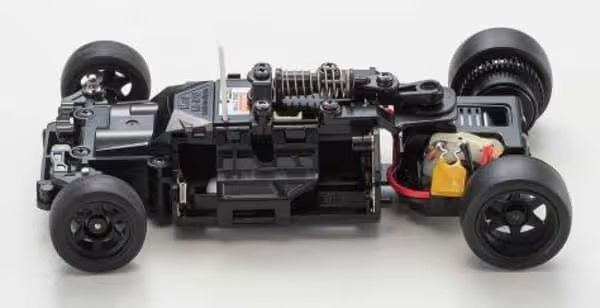
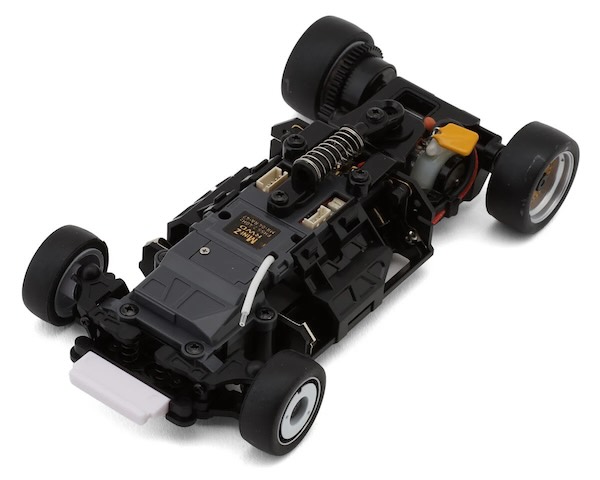
"Mini-Z" is the common shorthand for 1/28-scale on-road racing. Almost everything here applies across 1/28 on-road cars, not just Kyosho's Mini-Z — and the same motors turn up in 1/28 drift, which runs its own classes.
The motor is the part new 1/28 racers reach for first — and the one they should usually upgrade last. The factory motor in a Mini-Z is faster than most beginners can use, and on the tight, low-grip indoor tracks these cars run, more power is often slower: it just spins the tires. Kyosho literally created its slowest brushless motor because customers asked for one. Before you spend on a motor, fresh tires and the right pinion do more for your lap times.
Where the motor does matter is matching it to your class rules and your track. This guide covers the questions that confuse people most: brushed vs brushless, what "stock" actually means — which turns out to be a different motor at almost every club — and, updated for the current lineup, which motor actually ships in which kit.
Motor types at a glance
| Type | Rated in | What it means | Best for |
|---|---|---|---|
| Stock brushed (kit motor) | Turns (T) | More turns = more torque, lower RPM. The included motor. | Learning, box-stock classes |
| Upgrade brushed (Kyosho X-Speed, PN turn motors) | Turns (T) | Fewer turns = faster and hotter. ~70T is a common stock-legal motor; 30-40T is modified. | First upgrade, spec-brushed classes |
| Brushless, low KV (~3500-4100KV) | KV (rpm/volt) | Smooth, controllable, runs cool, lasts. The sweet spot for most tracks. | Most club racing, small tracks |
| Brushless, mid KV (~5000-5600KV) | KV | A handful unless you are experienced. | Larger tracks, advanced |
| Brushless, high KV (8500KV and up) | KV | Open/modified only — too fast for small layouts. | Big tracks, open class |
The key idea: brushed motors are rated in turns (lower = faster), brushless in KV (higher = faster). They are two different scales — you can't directly compare a "70T" to a "3500KV".
What KV actually means: Kyosho defines KV as the motor's unloaded RPM per volt applied — a 4100KV motor spins roughly 4,100 times a minute for every volt you feed it, per the spec sheet. Kyosho's own fine print adds a caveat worth taking seriously: printed KV figures are spec-sheet reference values, not a guarantee of that exact output on your particular can.
Brushed vs brushless — which should you run?
Brushless is the established upgrade: crisper throttle, smoother power, it runs cooler and lasts far longer than a brushed can. But two things trip people up:
- It's a system change, not a part swap. Brushless needs a brushless-capable board/ESC — Kyosho's EVO/VE chassis, or an aftermarket ESC from PN Racing or Atomic. You can't drop a brushless can into a brushed-only board.
- Pick low KV. 8500KV is unusable on a two-lane garage track; around 3500-4100KV is the comfortable range for most layouts. If a car is undriveably fast, the answer is usually less motor, not more.
Kyosho's current brushless generation (2026, badged XSPEED 41/56/85) is also sensored — a magnet-position sensor in the can gives the ESC precise rotor feedback, replacing the older sensorless brushless design. The practical upshot for a 1/28 racer: noticeably finer speed control and much smoother low-speed response versus the old sensorless motors, which is exactly where a lot of indoor-track driving happens.
The Kyosho brushless color ladder
Kyosho's brushless motors are color-coded by speed — the question people ask most. From slowest to fastest:
| Color | Relative speed | Typical use |
|---|---|---|
| Green | Slowest | Beginner / spec "stock" classes, small tracks |
| Blue | Medium | Popular all-round standard |
| Red | Fast | Faster / touring classes |
| Top tier | Fastest | Open / modified only |
We've left exact KV figures off the ladder on purpose: Kyosho has revised the KV ratings behind these colors across seasons, so the number printed on a current can is what counts. The order — green, blue, red, top — is what stays constant.
The current lineup (2026)
As of the 2026 catalog, Kyosho's sensored-brushless XSPEED family maps directly onto the current RWD and AWD flagship chassis:
| Motor | KV | Color | Ships standard in |
|---|---|---|---|
| XSPEED 41 | 4100KV | Green | MR-04EVO2, N-MM2 chassis configuration |
| XSPEED 56 | 5600KV | Blue | MR-04EVO2, W-MM chassis configuration |
| XSPEED 85 | 8500KV | Red | MR-04EVO2, W-MM configuration with V2 gyro; also standard on the MA-030EVO2 and MA-030 AWD chassis |
That lines up with the general ladder above — the 41 sits at the low end of the "most club racing" band, the 56 in the middle band, the 85 up in open/modified territory. Treat this table as what Kyosho currently ships as factory-standard on each chassis, not as a rule about what your own class allows — always confirm against your club's regulations before buying.
What "stock" really means (and why it's confusing)
There is no single "stock motor." What's legal depends entirely on where you race:
- Kyosho Mini-Z Cup (the main Japanese/official series): a mandated color motor (green/blue/red) with a rotation-speed cap enforced per class, plus a limited pinion. Rule change: starting in 2025, Kyosho moved Mini-Z Cup regulation from limiting motors by their printed KV rating to capping actual motor rotation speed (RPM) directly — a stricter, harder-to-game standard since it measures real output rather than a spec-sheet number. The cap is enforced electronically through the chassis's RC unit; on the current MR-04EVO2, class-by-class limits are set using Kyosho's I.C.S. Setting Manager software. If you've seen older write-ups (including earlier versions of this guide) describe Cup classes purely by KV rating, that's now out of date — the color of motor you run still has to be Cup-legal, but the number that actually gets checked is rotation speed, not KV.
- Club and PN World Cup stock: often the PN Racing 70-turn brushed motor (cheap), or a spec brushless like PN's 3500KV "PNWC Stock".
- Local clubs: brushless classes are usually KV-capped and tech-checked on a KV meter — for example a 2800KV ceiling for a LiPo-stock class — with aftermarket rotors banned.
Bottom line: check your club's rules before you buy a motor. The single most common beginner mistake is buying a motor that's illegal — or just pointless — for the class they'll actually run. (These numbers are examples; your club's will differ.)
Brushed options still on the shelf
Brushless gets the attention, but Kyosho still sells and supports dedicated brushed motors, and for two whole categories of Mini-Z they're the standard, not a downgrade:
- XSPEED Mini-Z Motor V (MZW301) — a brushed motor built for the RWD lineup, ICS-connector compatible so it drops straight into the same RC unit as the sensored brushless cans. It's the practical choice if your chassis or class isn't brushless-legal, or you just want a cheap, durable ICS-native motor.
- XSPEED AWD motor (MDW023) — the AWD-chassis equivalent, built for Mini-Z AWD platforms and ASF-compatible electronics.
- 130-class motors remain the standard on the Mini-Z Buggy platform (MB-010 / MB-010VE). Buggy is a different animal from the RWD/AWD touring-car lineup above — it's not part of the sensored-brushless XSPEED 41/56/85 ecosystem, and readysets in that line still ship with a conventional 130-class can.
Turns, KV, and how motor choice changes your gearing
Motor and pinion work together. Fewer winds (brushed) or higher KV (brushless) means more RPM and less torque; more winds or lower KV means more torque and less RPM. Match the pinion to the motor:
- Torquey motor (high-wind brushed / low-KV brushless) → pair with a larger pinion to put that torque to use.
- High-RPM motor (low-wind brushed / high-KV brushless) → pair with a smaller pinion, which lets you use the revs without overheating the motor or the board.
If a brushless car is too fast to drive, lower the gearing or drop to a lower-KV motor — don't reach for more power. On that front, the current MR-04EVO2 and MA-030EVO2 chassis kits already give you room to experiment: they ship with a set of four pinion gears (6T, 7T, 8T, 9T) in the box, so your first few gearing changes don't require an extra purchase — just swap within what came with the kit before buying anything else.
Maintenance and "is my motor dead?"
Brushed motors are a consumable — burning one out over time is normal, not a defect. Signs of a dying brushed motor: noticeably slower than it used to be, a hot "burnt-electrical" smell, an odd noise, or visible smoke. Blow the dust out with canned air now and then, and replace it when performance drops off. Brushless motors last far longer and need very little of this.
One catch that fools people: if the car runs fine off the track but bogs down under load, check for body or tire drag and a loose motor wire before blaming the motor.
Break-in is debated. Some racers do a brief, gentle low-voltage seat-in; others say modern motors don't need it, and water break-in in particular is best avoided on these small cans. There's no firm consensus, so don't feel you're missing a step by skipping it.
One motor, different platforms
The same small can motors are used across rear-drive and all-wheel-drive Mini-Z, and Kyosho's brushless motors appear in both RWD and AWD race classes. The current-generation chassis are the RWD MR-04 / MR-04EVO2 (the successor line to the older MR-03) and the AWD MA-020 / MA-030 / MA-030EVO2. What changes between platforms is the pinion and the drivetrain the motor drives (AWD spins a central driveshaft front and rear; RWD drives the rear pod only), not the motor can itself — the XSPEED 41/56/85 sensored brushless motors and the MZW301/MDW023 brushed motors are shared parts across the relevant chassis. The one platform that's genuinely different is the Buggy (MB-010) — see "Brushed options still on the shelf" above for why it still runs a conventional 130-class motor rather than the touring-car brushless lineup. Just buy the motor your chassis and class call for.
Where to get one
For the Kyosho factory path, the XSpeed brushless line is the easy choice — pick the color for your class and track:
- Kyosho XSpeed 41 (green, controllable) at AMain
- Kyosho XSpeed 56 (blue, all-round) at AMain
- Kyosho XSpeed 85 (red, fast) at AMain
For spec and stock classes, PN Racing (the 70-turn brushed and the 3500KV "PNWC Stock" brushless), Atomic, and ReFlex Racing are the names to know — most easily found through Mini-Z specialist shops.
Related Mini-Z guides: MR-03 vs MR-04 and how to upgrade · tires by track surface.