Tamiya's adjustable suspension mounts are one of the most powerful — and least explained — tuning systems in touring. Almost nothing in English lays out how the blocks and inserts actually combine to set toe, track and roll center. This guide does, straight from Tamiya's own 54880 setup chart.
The two layers
Every adjustable corner is two parts stacked together:
- The mount block — an alloy block labeled by letter: XB, A, or E (one-piece 54880/54881/54882, or "separate" 54883/54884/54885). The block sets the coarse position.
- The insert (bushing) — a small eccentric bushing that drops into the block, labeled N1 through N7. N1 is the standard, centered insert (no offset). The others move the suspension shaft off-center, and you can flip an insert to throw its offset inboard or outboard.
Each suspension arm is held by two of these mounts — an inner and an outer pivot. At the front they're labeled FF and FR (front-front, front-rear); at the rear, RF and RR (rear-front, rear-rear). The block sets where you start; the insert fine-tunes; the angle between the two mounts is what you feel.
What each insert does
- N1 — standard / centered. The baseline.
- N2, N3 — horizontal offset. These move the pivot in or out, which changes toe (and track). N2 is a small step, N3 a bigger one; flip the insert to go the other way.
- N4, N5, N6, N7 — vertical offset. These raise or lower the pivot, which sets roll center and, when paired unevenly front-to-rear, skid angle (anti-squat). The insert heights are 5.5 / 5.1 / 4.75 (standard) / 4.4 / 4.0 mm.
The position scale
A mount block plus its insert (and which way you flip it) lands the pivot on Tamiya's position scale, narrowest to widest:
XD · XC · XB · XA · X · A · B · C · D · E · F · G
Roughly, the XB block lives at the narrow end (around XD–XB), A in the middle (XA–C), and E at the wide end (C–G); the N-insert nudges you a step or two within that band.
Setting toe — the official chart
Toe (rear) or arm sweep (front) is simply the difference between the two mounts on one arm: every position-step equals 0.5°. Find your inner pivot down the side and your outer pivot across the top; the cell is the toe angle.
| XD | XC | XB | XA | X | A | B | C | D | E | F | G | |
|---|---|---|---|---|---|---|---|---|---|---|---|---|
| XD | 0° | |||||||||||
| XC | 0.5 | 0° | ||||||||||
| XB | 1.0 | 0.5 | 0° | |||||||||
| XA | 1.5 | 1.0 | 0.5 | 0° | ||||||||
| X | 2.0 | 1.5 | 1.0 | 0.5 | 0° | |||||||
| A | 2.5 | 2.0 | 1.5 | 1.0 | 0.5 | 0° | ||||||
| B | 3.0 | 2.5 | 2.0 | 1.5 | 1.0 | 0.5 | 0° | |||||
| C | 3.5 | 3.0 | 2.5 | 2.0 | 1.5 | 1.0 | 0.5 | 0° | ||||
| D | 4.0 | 3.5 | 3.0 | 2.5 | 2.0 | 1.5 | 1.0 | 0.5 | 0° | |||
| E | 4.5 | 4.0 | 3.5 | 3.0 | 2.5 | 2.0 | 1.5 | 1.0 | 0.5 | 0° | ||
| F | 5.0 | 4.5 | 4.0 | 3.5 | 3.0 | 2.5 | 2.0 | 1.5 | 1.0 | 0.5 | 0° | |
| G | 5.5 | 5.0 | 4.5 | 4.0 | 3.5 | 3.0 | 2.5 | 2.0 | 1.5 | 1.0 | 0.5 | 0° |
Worked example (from Tamiya's sheet): a rear arm on mount E (outer) and mount A (inner) with the standard N1 insert gives 2.0° rear toe-in. Move to an N2 insert and you get 2.5° or 1.5° depending on flip direction; N3 gives 3.0° or 1.0°. The trick most racers miss: you can reach the same toe at a different track width by choosing a different block pair that lands the same number of steps apart.
Track width
Three levers, coarse to fine: the insert offset and flip (inboard = arms closest together, outboard = arms farthest apart), wheel offset, and wheel spacers (0.5 / 0.75 / 1.0 mm). On the position scale, each step is about 0.75 mm of track per side (the full XD-to-G span ≈ 8.25 mm), so the same block move that changes toe also changes width. Changing the mount/insert also moves track, but it drags toe along with it — so set toe first, then trim track with wheel offset and spacers, inside the 190 mm class limit.
Roll center & anti-squat (skid)
Use the taller/shorter inserts (N4–N7) to raise or lower a pivot — that sets roll center. Pair a different height on the front mount versus the rear mount of the same arm and you tilt it, which creates skid angle (anti-squat) at the rear. Tamiya doesn't print a "degrees of anti-squat" number — it's tuned by feel in steps, not a published angle.
Parts & which chassis
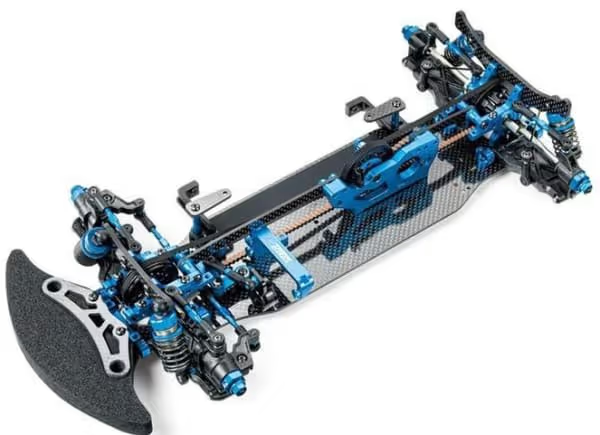
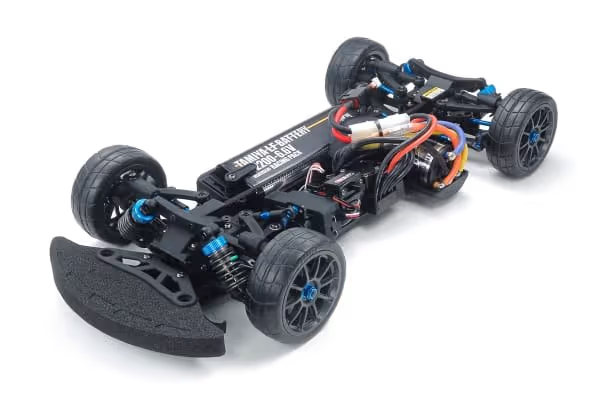
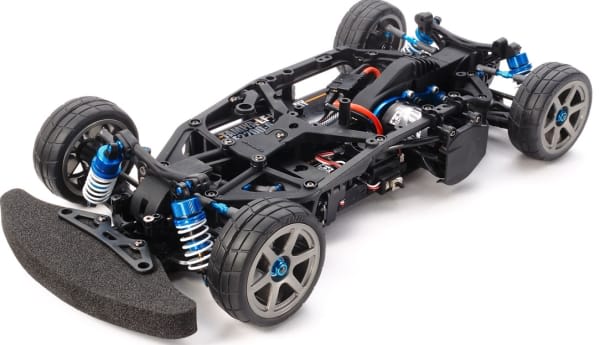
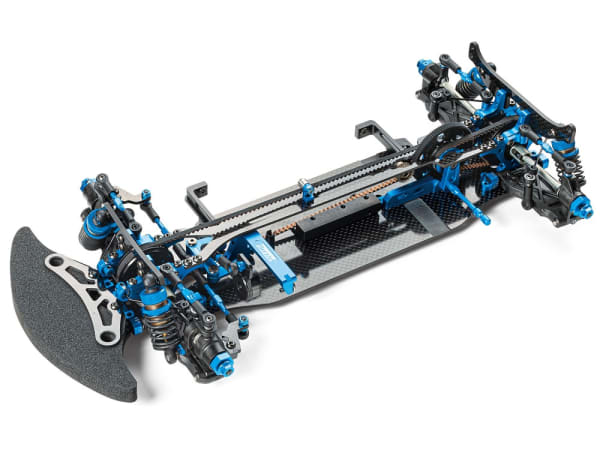
Alloy mounts 54880 (XB) / 54881 (A) / 54882 (E), separate versions 54883 / 54884 / 54885, brass versions 54935–54940, and the insert sprue 54922 (the N1–N7 bushings, 7 types). This one system is shared across TRF419, TRF420/420X, TRF421, TA07/TA07 PRO, TA08, TB05 — and the mounts/inserts cross-fit between them. Two forms, one system: the modern alloy mounts above (XB/A/E + N1–N7 inserts) and the classic individually-lettered plastic blocks — XD, XC, XB, XA, X, A, B, C, D, E, F, G, where you swap the whole block — land on the same position scale and the same toe chart. This lettered-mount system spans the whole Tamiya touring lineage — from the TRF414/415/416 era through the TB Evo series, TA05–TA08, TB02–TB05 and FF03/04 — all on the same position scale and toe chart (older cars use classic lettered plastic blocks; TRF419 onward use the alloy XB/A/E mounts with N1–N7 inserts, which mostly cross-fit). That includes the current TRF / TA family (TRF419–421, TA07, TA08, TB05). The TT-02 and TT-02 Type-S set rear toe a different way — the Type-S uses interchangeable rear uprights (TRF416- or 418-style) rather than these mounts — and the TC-01 has different geometry, so this chart doesn't apply to them in stock form (adjustable suspension mounts are available as a hop-up on some).
Related: Tamiya touring car spring chart.