
Your first LiPo charge can feel intimidating — RTR manuals are sparse, hobby-shop advice is hit-or-miss, and YouTube is full of people doing it five different ways. This guide is the version we wish we'd had: the actual safety floor, the first-charge walkthrough, and the handful of things that genuinely matter while you're learning.
See also: Once you're comfortable with the basics, the deep dive on LiPo charging for racers covers internal resistance, C-rate trade-offs, and the chemistry. For runtime planning, use the RC Battery Runtime Calculator.
LiPo safety: read this first
LiPos can catch fire if charged or damaged wrong. This is rare in normal use, but real enough that you should set up your bench correctly from day one. The rules:
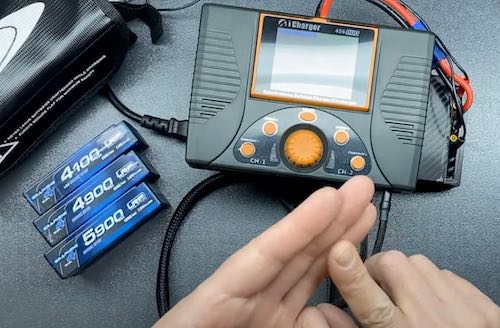
- Charge inside a LiPo bag on a non-flammable surface (concrete floor, ceramic tile, a metal ammo can). $20 well spent.
- Never leave a charging LiPo unattended. Stay in the room, check on it every few minutes.
- Use a real LiPo balance charger. Reedy, Hitec, Muchmore, SkyRC, and ProTek RC all make good ones. The wall-wart that came with your RTR may not balance properly — upgrade as soon as you can.
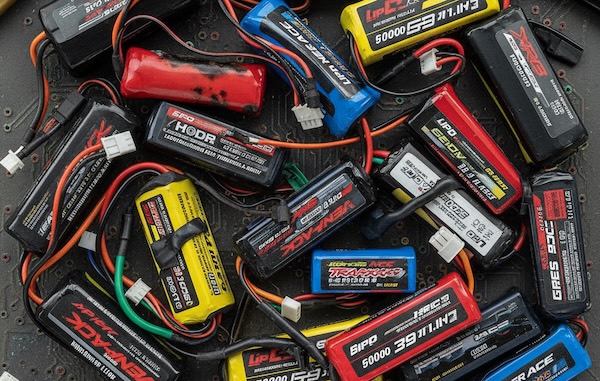
- Puffed (swollen) packs are done. If a pack looks bloated, stop using it. Storage-charge it, then dispose of it properly at a hobby shop or hazardous-waste site.
- Crashed packs that landed on something sharp need inspection. Physical damage to a cell can start a fire hours later. If a pack got hit hard, set it aside on concrete for an hour and watch for heat, swelling, or smoke before charging again.
What a LiPo actually is, in 60 seconds
A LiPo (lithium polymer) pack is made of one or more cells wired in series. Each cell is 3.7 V nominal when partly charged and 4.2 V when fully charged. So a "2S" pack (two cells) is 7.4 V nominal, 8.4 V full. A "3S" is 11.1 V nominal, 12.6 V full. And so on.
The numbers on the label tell you:
- 2S / 3S / 4S — how many cells, and therefore the voltage.
- 5000 mAh (or 6500, 8000, etc.) — how much energy the pack holds. Bigger number = longer runtime.
- 50C (or 100C, 120C, etc.) — how fast the pack can deliver current. For most stock and modified racing, anything 50C and up is fine.
Your first LiPo charge, step by step
- 1. Let the pack reach room temperature. Not cold from a garage in winter, not hot off the track. Room temperature, in your hand, before you plug it in.
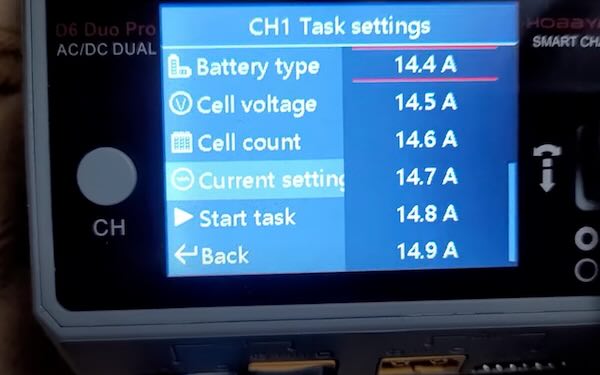
- 2. Set your charger. Select LiPo, set the cell count to match your pack (2S, 3S, etc.), select balance charge, set the charge rate to 1C (see below for what that means).
- 3. Plug in both leads. The fat main lead (deans, EC5, XT60 — whatever your pack uses) and the smaller balance lead with the white plug. Both have to be connected for balance charging to work.
- 4. Start the charge. The charger displays voltage and amps. As the pack fills up, the charge current tapers down — this is normal.
- 5. Wait for the beep. Charger signals done. Unplug, give the pack a minute to settle, then it's ready to use.
That's it. The whole process takes about an hour at 1C for a typical pack.
What "1C" means (and why you should care)
"C" is just the pack capacity expressed in amps. A 5000 mAh pack:
- 1C = 5 A charge rate. Fills the pack in ~1 hour. Gentle on the cells.
- 2C = 10 A. Fills in ~30 min. Small life trade-off.
- 3C = 15 A. Race-day pace. Costs you some pack life over time.
- 5C+ = aggressive. Faster wear. Don't do this every day.
For your first 20–30 cycles on a pack, charge at 1C. Once you're comfortable and need race-day speed, 2–3C is a defensible trade.
What "balance charge" means
The cells in your pack are never perfectly identical. Each cycle, they drift a few millivolts apart. Balance charging uses the smaller white connector to read and equalize each cell at the top of every charge, so no single cell ends up over 4.20 V (which damages it) while another sits at 4.10 V.
Always balance charge. Every cycle. No exceptions. The time cost is under a minute on a healthy pack, and skipping it lets cells drift apart in ways that are hard to recover from.
How to store LiPo batteries between races
This is the #1 mistake new racers make: leaving fully-charged packs on the bench for weeks. A LiPo at 4.20 V/cell loses capacity steadily while it sits — about 20% per year at room temperature, more if it's hot.
The fix is your charger's Storage mode. It charges (or discharges) the pack to about 3.85 V/cell, which is the calendar-aging sweet spot. The rules:
- You'll race again in 1–2 days: leave the pack at full charge. The cost is negligible.
- You won't race for 3+ days: storage-charge it before putting it away.
- End of season: storage-charge everything. Store in a cool place (basement, air-conditioned closet — not a hot garage in summer).
The four things that kill LiPo packs fast
- 1. Running them too low. Below 3.0 V/cell, the chemistry starts breaking down — eventually copper inside the cell dissolves and shorts the pack. Set your ESC's cutoff voltage, and stop the run when the car feels noticeably weak.
- 2. Charging cold. Below freezing, lithium plates out as metal on the anode instead of intercalating where it belongs. That's permanent capacity loss and a safety risk. Always let cold packs warm to room temperature before charging.
- 3. Charging hot off the track. A pack that just came off the car is often 100–130 °F (38–55 °C). Charging stacks more heat on top of that and stresses the chemistry. Let the pack cool to under about 100 °F (38 °C) before plugging in — a cheap IR thermometer is plenty.
- 4. Physical damage. Hard crashes that hit the pack can puncture or short a cell. Symptoms: swelling, heat, or smoke. If anything seems off, put the pack on concrete in a LiPo bag, watch it for an hour, and replace it.
Things to ignore for now
RC battery threads online go deep on a lot of details that don't matter to a newer racer. Don't worry about these yet:
- Internal resistance (IR) numbers. Your charger may show "IR" in milliohms per cell. It's a real signal of pack health, but the numbers aren't comparable across chargers, and tracking the trend over many cycles is what matters. Read the deep-dive guide when you're ready.
- HV LiPos (4.35 V/cell). Higher peak voltage = more punch but shorter pack life. Stick with standard 4.20 V LiPos until you know your class allows HV and you want the trade.
- Cell matching, punch ratings, "race-prep" rituals. Top-level race team obsession territory. Doesn't help while you're still learning to drive consistently.
Quick reference
- Charge: in a LiPo bag, at 1C, balance mode, pack at room temperature.
- Store: at 3.85 V/cell if you won't race within 1–2 days.
- Discharge floor: stop at 3.0 V/cell or higher. Never run dead-flat.
- Cool first: sub-100 °F (38 °C) before plugging in after a run.
- Never: leave a charging pack unattended, charge cold, charge puffed packs, or skip balance.
Next steps
- LiPo Charging for RC Racers: What the Science Actually Says — the in-depth version of this article, with the chemistry, IR measurement methods, and race-day protocols.
- RC Battery Runtime Calculator — work out runtime from pack capacity, motor amp draw, and gearing.