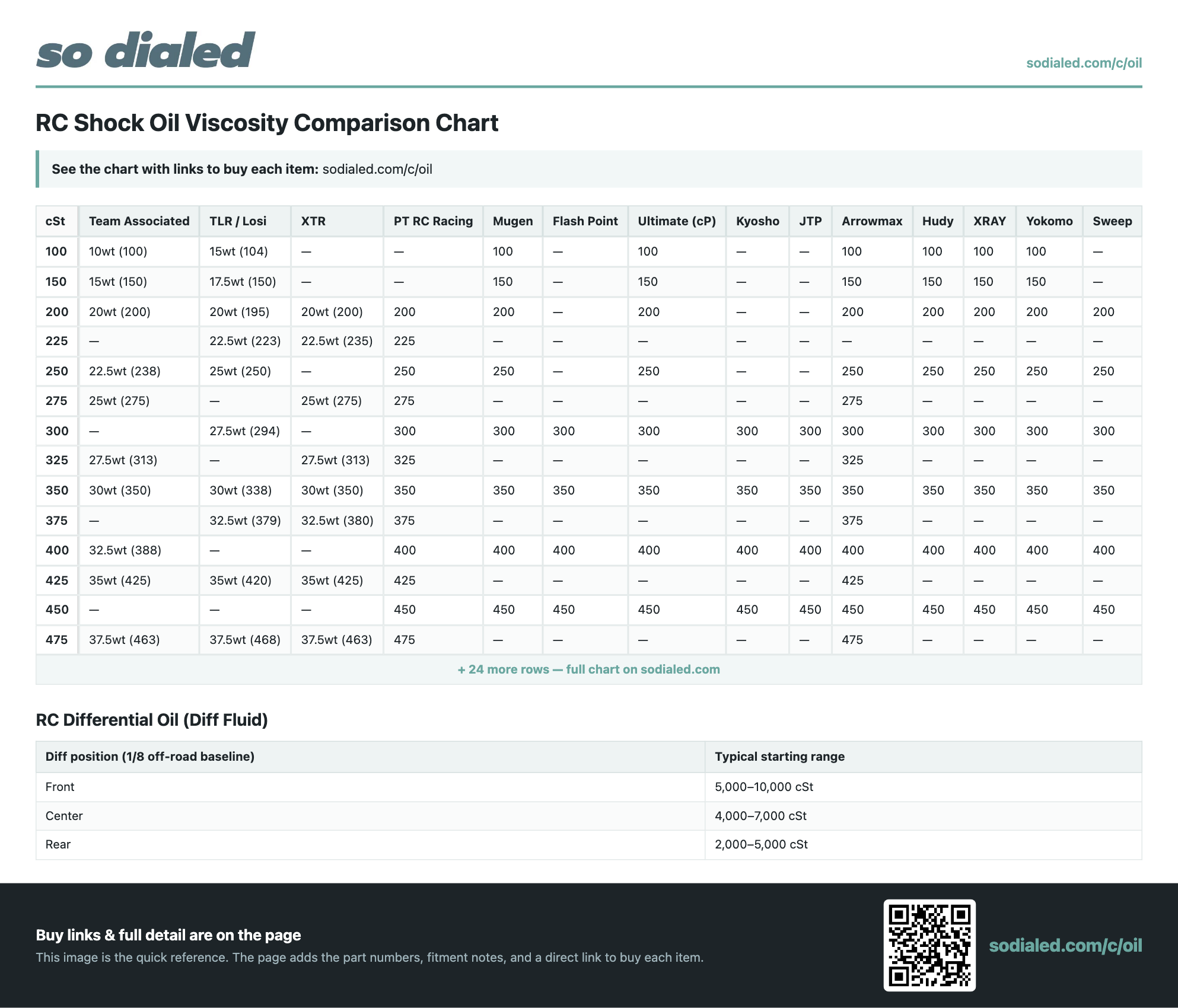
Every brand labels silicone shock oil differently. Team Associated, TLR, and XTR sell by weight (wt), while most other brands label their bottles directly in centistokes (cSt) — the international standard for silicone-oil viscosity. The catch: "wt" is not a standardized unit, so 30wt from one brand is not the same thickness as 30wt from another. The chart below puts every brand on the same cSt scale so you can match viscosity across brands. (Ultimate labels its oils in cP — for silicone oil, cP and cSt are numerically identical.)
Shock Oil: Weight (wt) to cSt by Brand
Rows are viscosity in cSt. For Team Associated, TLR, and XTR the cell shows the brand's wt label with its true cSt in parentheses. Linked values go straight to that exact oil at AMain (affiliate links). The table scrolls sideways — the cSt column stays put.
| cSt | Team Associated | TLR / Losi | XTR | PT RC Racing | Mugen | Flash Point | Ultimate (cP) | Kyosho | JTP | Arrowmax | Hudy | XRAY | Yokomo | Sweep |
|---|---|---|---|---|---|---|---|---|---|---|---|---|---|---|
| 100 | 10wt (100) | 15wt (104) | — | — | 100 | — | 100 | — | — | 100 | 100 | 100 | 100 | — |
| 150 | 15wt (150) | 17.5wt (150) | — | — | 150 | — | 150 | — | — | 150 | 150 | 150 | 150 | — |
| 200 | 20wt (200) | 20wt (195) | 20wt (200) | 200 | 200 | — | 200 | — | — | 200 | 200 | 200 | 200 | 200 |
| 225 | — | 22.5wt (223) | 22.5wt (235) | 225 | — | — | — | — | — | — | — | — | — | — |
| 250 | 22.5wt (238) | 25wt (250) | — | 250 | 250 | — | 250 | — | — | 250 | 250 | 250 | 250 | 250 |
| 275 | 25wt (275) | — | 25wt (275) | 275 | — | — | — | — | — | 275 | — | — | — | — |
| 300 | — | 27.5wt (294) | — | 300 | 300 | 300 | 300 | 300 | 300 | 300 | 300 | 300 | 300 | 300 |
| 325 | 27.5wt (313) | — | 27.5wt (313) | 325 | — | — | — | — | — | 325 | — | — | — | — |
| 350 | 30wt (350) | 30wt (338) | 30wt (350) | 350 | 350 | 350 | 350 | 350 | 350 | 350 | 350 | 350 | 350 | 350 |
| 375 | — | 32.5wt (379) | 32.5wt (380) | 375 | — | — | — | — | — | 375 | — | — | — | — |
| 400 | 32.5wt (388) | — | — | 400 | 400 | 400 | 400 | 400 | 400 | 400 | 400 | 400 | 400 | 400 |
| 425 | 35wt (425) | 35wt (420) | 35wt (425) | 425 | — | — | — | — | — | 425 | — | — | — | — |
| 450 | — | — | — | 450 | 450 | 450 | 450 | 450 | 450 | 450 | 450 | 450 | 450 | 450 |
| 475 | 37.5wt (463) | 37.5wt (468) | 37.5wt (463) | 475 | — | — | — | — | — | 475 | — | — | — | — |
| 500 | 40wt (500) | — | 40wt (500) | 500 | 500 | 500 | 500 | 500 | 500 | 500 | 500 | 500 | 500 | 500 |
| 525 | — | 40wt (516) | 42.5wt (528) | 525 | — | — | — | — | — | 525 | — | — | — | — |
| 550 | 42.5wt (538) | — | — | 550 | 550 | 550 | 550 | 550 | 550 | 550 | — | — | 550 | 550 |
| 575 | 45wt (575) | 42.5wt (563) | 45wt (575) | 575 | — | — | — | — | — | 575 | — | — | — | — |
| 600 | — | 45wt (610) | — | 600 | 600 | 600 | 600 | 600 | 600 | 600 | 600 | 600 | 600 | 600 |
| 625 | 47.5wt (613) | — | 47.5wt (614) | 625 | — | — | — | — | — | — | — | — | — | — |
| 650 | 50wt (640) | 47.5wt (660) | 50wt (650) | 650 | 650 | 650 | 650 | 650 | 650 | 650 | — | — | 650 | 650 |
| 675 | — | — | — | 675 | — | — | — | — | — | — | — | — | — | — |
| 700 | — | 50wt (710) | — | 700 | 700 | 700 | 700 | 700 | 700 | 700 | 700 | 700 | 700 | 700 |
| 725 | 55wt (725) | — | 55wt (725) | 725 | — | — | — | — | — | — | — | — | — | — |
| 750 | — | 55wt (760) | — | 750 | — | 750 | 750 | 750 | 750 | 750 | — | — | — | 750 |
| 775 | — | — | — | 775 | — | — | — | — | — | — | — | — | — | — |
| 800 | 60wt (800) | 60wt (810) | 60wt (800) | 800 | 800 | 800 | 800 | 800 | 800 | 800 | 800 | 800 | — | 800 |
| 825 | — | — | — | 825 | — | — | — | — | — | — | — | — | — | — |
| 850 | — | — | — | 850 | — | 850 | 850 | 850 | — | 850 | — | — | — | 850 |
| 875 | — | — | 65wt (875) | 875 | — | — | — | — | — | — | — | — | — | — |
| 900 | 70wt (900) | 70wt (910) | — | 900 | 900 | 900 | 900 | — | — | 900 | 900 | 900 | — | 900 |
| 925 | — | — | — | 925 | — | — | — | — | — | — | — | — | — | — |
| 950 | — | — | 70wt (950) | 950 | — | 950 | 950 | — | — | 950 | — | — | — | 950 |
| 975 | — | — | — | 975 | — | — | — | — | — | — | — | — | — | — |
| 1000 | — | 80wt (1014) | — | 1000 | — | — | 1000 | — | — | — | 1000 | 1000 | 1000 | — |
| 1100 | — | 90wt (1130) | — | 1100 | — | — | — | — | — | — | — | — | — | — |
| 1200 | — | — | — | 1200 | — | — | — | — | — | — | — | — | — | — |
| 1300 | — | 100wt (1325) | — | 1300 | — | — | — | — | — | — | — | — | — | — |
Reading the chart: if a setup sheet calls for 400 cSt and you run Associated oil, 32.5wt (388 cSt) is the closest match. If you're switching brands, match the cSt number, not the wt number.
RC Differential Oil (Diff Fluid)
Diff fluid is the same silicone oil, just far thicker — typically 1,000 to 1,000,000 cSt. At these viscosities brands use "wt" and "cSt" interchangeably (Kyosho's 1,000,000wt is 1,000,000 cSt), so the number on the bottle is directly comparable across brands and no conversion chart is needed. Thicker fluid makes the diff act more locked; thinner fluid lets the wheels differentiate more freely.
Which weight should you run? That depends on the car. The RC Diff Oil Chart lists front, center and rear weights for most current 1/8 and 1/10 off-road race cars, along with the range most racers run at each position.
Popular diff fluids: Team Associated (2 oz), TLR (30 ml), Mugen (50 ml), Kyosho (40 cc), Flash Point (75 ml), and Hudy (100 ml).
What About Tamiya and Traxxas?
Tamiya's silicone damper oils use # numbers (#100–#1000) that correspond directly to cSt, so they slot straight into the cSt column above with no conversion. Traxxas oils are labeled in wt on Traxxas's own scale and were not part of the original test data, so they are not included in the conversion chart.
Conversion data originally compiled by RC Car Stars (rccarstars.com), based on manufacturers' stated cSt values or viscosity testing by the manufacturers' test facilities. Centistokes (cSt) is the world standard for measuring silicone-oil viscosity; centipoise (cP) is numerically identical for these oils. Some links above are affiliate links that support the site.