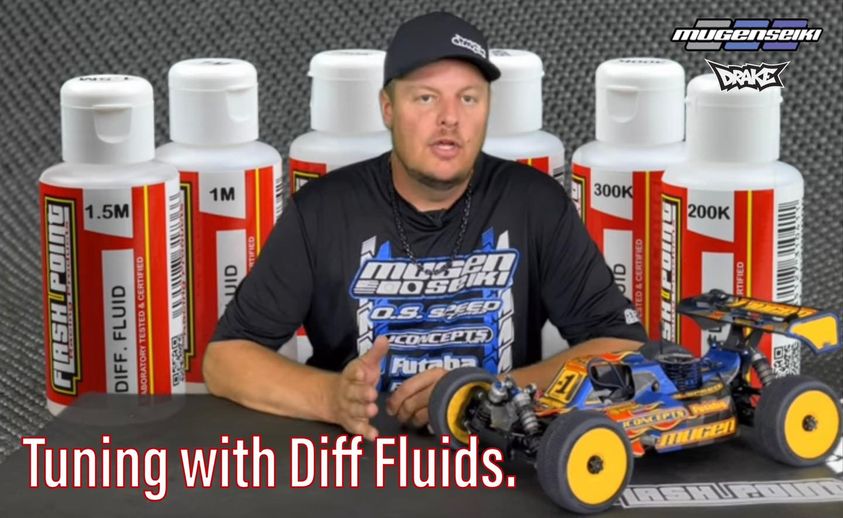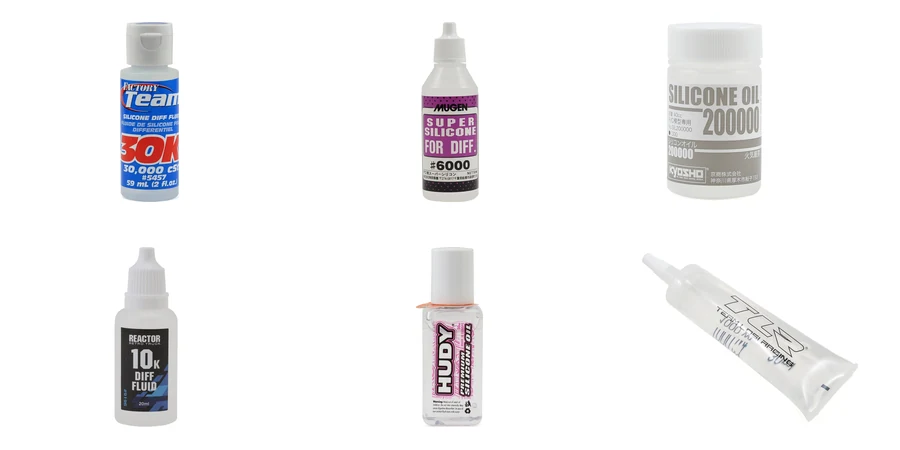
Wondering what diff fluid you should run in your off-road RC car? Check out the tables below to find a starting point - most popular current race cars are listed, including short course trucks. The bold number is a viscosity (weight) that should work in most conditions. The range shown below each number shows the range that most racers use for that car. People normally use thicker fluid on smooth, high grip tracks (especially carpet), and lighter fluid on low-grip dirt tracks. All figures are in cSt.
1/8 Off-Road Diff Fluid Weights - Buggy & Truggy
Car | Front | Center | Rear |
|---|---|---|---|
Team Associated RC8 B4.1e | 9,000 | 8,000 | 6,000 |
Team Associated RC8 T4e | 15,000 | 10,000 | 7,000 |
Team Associated RC8 B4.1 | 8,000 | 10,000 | 7,000 |
Team Associated RC8 B4e | 8,000 | 6,000 | 6,000 |
Team Associated RC8 B3.2 | 7,000 | 7,000 | 6,000 |
Team Associated RC8 T3.2e | 10,000 | ||
Team Associated RC8 B4 | 7,000 | 7,000 | 6,000 |
Team Associated RC8 B3.2e | 10,000 | 7,000 | 5,000 |
TLR 8IGHT-XE 2.0 | 7,000 | 5,000 | 4,000 |
TLR 8IGHT-X Elite | 7,000 | 7,000 | 4,000 |
TLR 8IGHT-XE Elite | 7,000 | 4,000 | |
TLR 8IGHT-X 2.0 | 12,500 | 10,000 | 7,000 |
TLR 8IGHT-XE | 7,000 | 3,000 | |
Tekno EB48 2.0 | 9,000 | 7,000 | 5,000 |
Tekno EB48 2.2 | 10,000 | 7,000 | 5,000 |
Tekno NB48 2.2 | 8,000 | 8,000 | 5,000 |
Tekno EB48 2.1 | 8,000 | 7,000 | 6,000 |
HB D819RS | 7,000 | 5,000 | 3,000 |
HB E819RS | 7,000 | 5,000 | 2,000 |
Mugen Seiki MBX8 Worlds Edition | 7,000 | 7,000 | 5,000 |
Mugen Seiki MBX8 | 7,000 | 4,000 | 3,000 |
Mugen Seiki MBX8R | 8,000 | 8,000 | 5,000 |
Mugen Seiki MBX8TR ECO | 10,000 | 10,000 | |
Kyosho Inferno MP10 | 7,000 | 7,000 | 5,000 |
XRAY XB8E '20-'22 | 7,000 | 7,000 | 3,000 |
ARRMA Typhon TLR-Tuned | 9,000 | 5,000 | |
Serpent SRX8 PRO | 7,000 | 8,000 | 3,000 |
Serpent SRX8E PRO | 7,000 | 7,000 | 3,000 |
Serpent SRX8E | 7,000 | 7,000 | 3,000 |
Serpent SRX8T | 7,000 | 7,000 | 5,000 |
SWORKz S35-4 | 7,000 | 7,000 | 4,000 |
All values in cSt.
Truggy vs Buggy Baselines
If your truggy isn't in the 1/8 table above, start from the buggy on the same platform and go thicker/heavier. Truggies of course, have bigger, heavier tires and load the drivetrain harder, so thicker fluids are necessary. So, if you know what fluid you use in a buggy, you can scale that number up, roughly following these ratios:
Diff | Typical increase over your buggy oil | Example |
|---|---|---|
Front | ×1.5 (buggy weight x 1.5 = truggy weight) | 8,000 → 12,000 |
Center | ×1.5 | 8,000 → 12,000 |
Rear | ×1.25 | 4,000 → 5,000 |
This is a starting direction, not an exact formula — some platforms move more than others.
1/10 Off-Road Diff Fluid Weights - 4WD
A dash in the center column means the car has no fluid-filled center diff, so there is nothing to set there.
Car | Front | Center | Rear |
|---|---|---|---|
Team Associated RC10 B74.1 | 10,000 | 200,000 | 10,000 |
Team Associated RC10 B74.2/D | 15,000 | 200,000 | 15,000 |
Team Associated RC10 B74.1D | 8,000 | 200,000 | 7,000 |
Team Associated RC10 B74 | 10,000 | 7,000 | |
TLR 22X-4 | 7,000 | 500,000 | 5,000 |
TLR 22X-4 2.0 | 10,000 | 500,000 | 7,000 |
Tekno ET410.2 | 7,000 | 100,000 | 7,000 |
Tekno EB410.2 | 12,500 | 40,000 | 10,000 |
Schumacher CAT L1R | 12,500 | — | 12,500 |
Schumacher CAT PB | 12,500 | — | 12,500 |
Serpent SRX4 Gen3 | 15,000 | — | 10,000 |
All values in cSt.
Center diff or slipper?
Some 1/10 4WD cars use a center diff, some use a slipper clutch, and some let you run either. If you're not sure which to run, check out some of these guides:
Should You Use a Slipper or Differential in the Middle of your 4WD RC Car?
Slipper clutch and differential fluid in the settings guide
Choosing diff oils for the front, center and rear
The exact numbers change from car to car, but how front, center and rear compare to each other stays much the same within a class. Use it to sanity-check a setup, or to get close on a car that isn't in the tables.
Class | Front | Center | Rear |
|---|---|---|---|
1/8 off-road | 1.8× | 1.7× | 1× |
1/10 4WD | 1× | 25× | 1× |
In 1/8 the front and center are usually similar, and they both run roughly three-quarters thicker (rear weight x 1.75) than the rear. In 1/10 4WD the front and rear usually match, and the center is usually much heavier.
1/10 Off-Road Diff Fluid Weights - 2WD
A 2WD buggy has one differential, in the transmission, and it is either a gear or ball diff.
A gear diff is a sealed case filled with silicone oil. You choose the oil's viscosity (weight) to tune the differential's behavior. Heavier oils give more resistance to the differential action and are typically used for smooth, high-grip tracks.
A ball diff has grease for lubrication, and it's behavior is set by how tight you set the diff screw. Setup sheets usually note the diff setting as “med tight” or a number of turns back from fully tight.
Not sure which one is in your car? Look for a slotted screw through the outdrive - that is used for adjusting the ball diff, and a gear diff does not have one.
Which diff to run
Most cars are sold in two versions. Team Associated do a carpet-oriented B7 and a dirt-oriented B7D; XRAY do the same with the XB2C and XB2D. Do not go by the badge, though — plenty of racers swap the diff once their track's grip comes up.
The more grip, the more likely you want a gear diff. Ball diffs are the norm on dirt and medium-grip clay. Gear diffs take over on carpet, and on astroturf and smooth high-grip clay.
Gear diff oil by car, 2WD
Car | Typical fluid | Range racers run |
|---|---|---|
Team Associated B6 series | 6,000–10,000 | |
Team Associated B7 & B7.1 | 60,000–150,000 | |
Team Associated T6 (truck) | 7,000–15,000 | |
TLR 22 5.0 & 22X | 5,000–30,000 | |
XRAY XB2 | 3,000–200,000 | |
Schumacher Cougar LD2 | 3,000–50,000 | |
Schumacher Cougar LD3 | 5,000–200,000 | |
Yokomo YZ-2 | 3,000–12,500 |
All values in cSt.
Grip moves this number more than anything else. The XRAY XB2 shows it best — the same buggy runs 7,000 on a low-grip track and 80,000 on a high-bite one.
Short Course Truck Diff Fluid Weights
These are the manufacturers’ own kit settings, read from each truck’s manual or kit setup sheet, rather than a racer average. A short course truck carries a heavier body and more roll than the buggy it shares a platform with, so it runs thicker fluid, and the front is usually much thicker than the rear to keep the truck from pushing on power. A dash means there is nothing to fill in that position.
Car | Front | Center | Rear |
|---|---|---|---|
Team Associated SC10 4x4 | — | ||
Team Associated Pro4 SC10 | |||
Tekno SCT410 2.0 | |||
Tekno SCT410.3 | |||
Tekno SCT410SL | |||
Traxxas Slash 4X4 | — |
Two of those need a word. The SC10 4x4 has no center diff, and Associated’s two manuals for it disagree: the earlier one says 3,000 cSt to start with 2,000–7,000 covering most conditions, the Factory Team manual says 30,000 front and 5,000 rear. The Factory Team numbers are the ones to run. The Slash 4X4 leaves the factory with 30,000 in the front and 100,000 in the center drive, except the Brushless LCG edition, which Traxxas fills with 500,000 up front; Traxxas does not publish a weight for the rear.
The 2WD trucks mostly take no fluid at all
Team Associated’s 2WD short course trucks — the SC6.1, SC6.2, SC6.4 and SC7, and the whole SC10 series — build a ball differential in the kit, which is set with the thrust screw rather than with fluid, so there is no weight to choose. Associated does sell an optional sealed gear diff for the SC10 series (#9827) but publishes no starting weight for it. The exception in this class is the XRAY SCX, whose kit gear diff takes 5,000 cSt.
What fluid viscosity (weight) does
Once you have a baseline, this is which way to move it. These effects hold on any car.
Diff | Thicker | Thinner |
|---|---|---|
Front | More steering off-power and into the corner; can push mid-corner and make the car harder to turn on power | Frees the front, more on-power steering, less entry bite |
Center | More forward drive on power, more stable on rough ground; harder to rotate, more understeer | Easier to rotate, more responsive; can spin up and lose drive on low grip |
Rear | More rear traction and stability on power, more forward bite | More rotation and steering on power; less side bite |
Grip is the main lever: thicker as it comes up, thinner as the track gets loose, dusty or bumpy. Big jumps are the exception — a thicker center keeps the car settled in the air and on landing, rough track or not.
Going deeper: Off-road Differential Tuning with Dakotah Phend, How to Choose Diff Fluid for your Off-road RC Car, Choosing 4WD Diff Oil for Off-road, and What is “diffing out”?
Where to buy diff fluid
Each link opens that brand's diff oil at AMain, where you pick the weight you need.
Brand | Bottle | |
|---|---|---|
Team Associated | 2 oz | |
TLR | 30 ml | |
Mugen Seiki | 50 ml | |
Kyosho | 40 cc | |
JConcepts | 20 ml | |
Hudy | 50 ml | |
Core-RC | 50 ml | |
1UP Racing | — | |
Flash Point | 75 ml | |
J&T Bearing Co. | 2 oz | |
Pit Bull | 2 oz | |
Traxxas | — |
You do not have to match the brand of your car. Every brand labels diff oil in cSt, but there is usually some variation in actual viscosity between fluids from different brands even if they are labeled as the same weight.
Setting up shocks too? See the RC shock oil viscosity chart — shock oil is labeled differently by brand and does need converting.